Why does generative AI keep giving different answers to the same question?
The answer
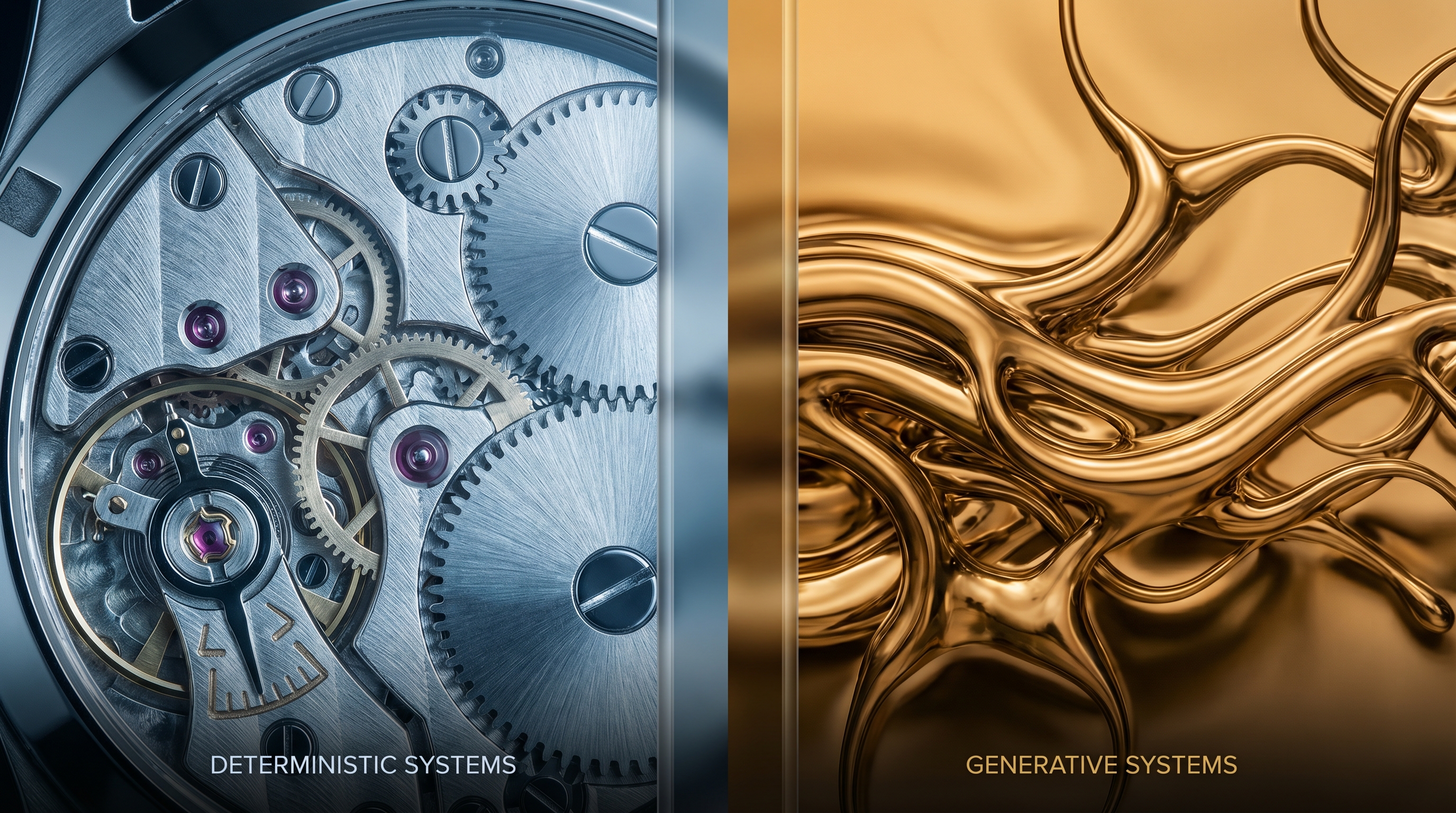
Generative AI gives different answers because it is probabilistic by design. It predicts the most likely next word with built-in randomness. That randomness is what makes it creative. It is also what makes it unreliable for business decisions. You would not trust a calculator that gave slightly different answers each time. For the same reason, you should not trust a generative model with decisions that need to be consistent and auditable.
Source: SynthesisArc, 2026
The full picture
When you ask ChatGPT a question, it does not look up the answer. It predicts what words are most likely to come next based on patterns in its training data. Each prediction includes a small amount of randomness, which is what makes the output feel natural and varied. Ask the same question twice and the randomness produces a slightly different path, which produces a slightly different answer.
For creative tasks, this is a feature. You want variety in a brainstorming session. You want different draft options for an email. The randomness adds value because the task benefits from variation.
For operational decisions, this is a serious problem. If your AI classifies the same invoice differently on Tuesday than it did on Monday, you cannot audit it. If your compliance model gives inconsistent risk ratings on identical cases, you cannot defend it to a regulator. Consistency is not optional for decisions that affect money, safety, or compliance.
The fix is not to turn off the randomness. Even at temperature zero, generative models can produce slightly different outputs. The fix is to use deterministic AI at the decision layer and reserve generative AI for the tasks where variation is acceptable. SynthesisArc's PRISM architecture does exactly this.
Apply this thinking
The SynthesisArc products that put this into production.
Go deeper
Field Notes on this topic.
Ready to put this into production?