
From operational intelligence to market visibility
Wemakeyourbusinessimpossibletoignore.
You become THE option, not one of many. That happens when your business runs smooth on the inside and shows up everywhere your customers are looking on the outside.

Professional Sports
500x Search Traffic in 5 Months. A Century-Old Brand Rebuilt.
Read the case study
Healthcare / Dental
From #5 to #1: 340% ROI for a Top-Rated Practice
Read the case study
Restaurant & Hospitality
A 117-Location Restaurant Chain's 493% Organic Click Surge
Read the case study
Logistics & Supply Chain
A $75M Trucking Company Stopped Losing $200K a Month
Read the case study
Healthcare
A Clinical Lead Caught a $240K Mistake Before Print
Read the case study
Professional Services
$300K Exposure Avoided in 4 Days. A Founder's Business Recovered.
Read the case studyWhat it takes to be impossible to ignore
Two halves of what every modern business needs. Most companies have one.
Operational Intelligence
Most companies use AI like a tool. Open it, ask it a thing, close it. The companies pulling ahead run AI as the operating system underneath everything. Every workflow, every decision, every process flowing through one intelligent layer that learns and gets sharper every week.
Not a tool you open. The layer your business runs on.
Market Visibility
The moment your buyers stop typing into Google search and start asking ChatGPT, most companies disappear. Yours doesn't. You show up across ChatGPT, Claude, Perplexity, and Google AI Overviews. Cited, ranked, and remembered.
Sixty percent of searches no longer click a link. We make sure you're already in the answer.
Why both. Why together.
Neither half works without the other.
Operations without visibility
A best-kept secret.
Excellent work nobody knows about. The trap that quietly kills capable companies who do everything right except show up where buyers are now looking.
Visibility without operations
A house of cards.
Demand floods in from every search and every AI answer, and the business can't keep up. Churn climbs. Reputation tanks. Marketing-led growth turns into a fire you can't put out.
Inside feeds outside
Built together, they compound. Operational intelligence produces outcomes you can actually stand behind, and those outcomes become the proof your market visibility cites. Real results land first. The claims that earn citations follow.
Outside feeds inside
Visibility brings demand. Operations absorb it without breaking. More demand produces more outcomes. More outcomes fuel more visibility. Each half makes the other one stronger.
That's the loop. Run one alone and you're stuck in one of the two traps. Run them together as a single circuit, and you'll compound on yourself month after month.
Most agencies do one half. Most consultancies do the other half. As an enterprise, we build both, together, as a single system. That's what makes a business impossible to ignore.
What We Do
We don't sell you AI.
We make your operations smarter.
We diagnose your operations. We deploy AI where it will actually move the needle. And we hand you the keys when we leave. Not theory. Not pilots. Not PowerPoints.
Find
We tell you exactly where your operations are losing money.
Our two-week diagnostic maps your workflows, finds the inefficiencies, and puts a dollar figure on every opportunity. You get a prioritized roadmap, not a 200-page slide deck. No guessing. Just clarity.
- 2-Week AI Readiness Assessment
- Workflow Mapping
- ROI Prioritization
Fix
We build AI around the work that matters most. Same answer, every time.
Most AI gives you a different answer every time you ask the same question. We build the kind that doesn't. Measurable results in 90 days, or you don't pay. No experiments. No pilots that never ship.
- AI Workflow Automation
- 90-Day Guarantee
- Measurable ROI
Future-Proof
Your team runs it. No retainer. No lock-in.
We build the systems, then transfer them completely. Full documentation, hands-on training, clean handoff. You own the workflows, the data, and the outcomes. We don't build things you can't live without us for. That's the point.
- Full Knowledge Transfer
- Your Team Owns It
- No Lock-In
Two weeks. Your three highest-impact AI opportunities. Dollar figures attached.
Where you are right now
Every business is collapsing into one of three states.
The shift is already happening. The only question is which side of it you're on when the dust settles.
THE option.
Operations running on intelligence that learns. Visibility everywhere your buyers look. The category your competitors quietly study.
Impossible to ignore.
A survivor.
Some AI plugged in. Some operational lift. Some traffic. The pieces are moving but the system isn't compounding yet. Still one of many options on the buyer's list.
Holding ground. Not gaining it.
Falling behind quietly.
Same workflows. Same org chart. Same outputs you can't quite bet on. Faster competitors are pulling ahead and the gap compounds week by week.
The longer the wait, the wider the gap.
We diagnose where you are in two weeks. Then we build the path to category one.
Find out which state you're inWhat We've Built
Four systems. One platform.
Built for outcomes you can bet on.
Most AI vendors sell you a model. We built the rest of the stack so the model can actually do the job. Every answer consistent, every result measurable, and you own all of it.
INSIGHTS: a two-week AI readiness assessment
Before you spend a dollar on AI, you need to know exactly where it will move the needle, and by how much. INSIGHTS is our two-week diagnostic that maps your operations, identifies your three highest-impact AI opportunities, and puts a dollar figure on each one. A prioritized roadmap. Not a theory.
PRISM: AI that gives the same answer every time
Most AI treats every request like a brand-new stranger. No memory, no context, a different answer each time you ask. PRISM fixes that. It gives your AI a real memory, a way to think things through step by step, and the ability to give the same answer to the same question, every single time. The difference between a tool that might help and a system you can actually run a business on.
Precognition: get found when buyers ask AI
Sixty percent of searches never click a link anymore. Your buyers are asking ChatGPT, Claude, and Perplexity the questions they used to ask Google. Precognition makes sure you show up across every AI surface where your buyers are looking, and tracks how often you get cited.
Claude Guard: AI that's safe to put in front of your customers
Most AI vendors hand you a chat box and hope for the best. Claude Guard is the security layer for AI that has to live in a real business. Every decision logged. Every piece of data encrypted. SOC 2, HIPAA, GDPR ready. On-premise if you need it. Built for the buyer who has to answer to a board.
Becoming THE option starts with knowing exactly where to focus.
The INSIGHTS assessment maps your operations, ranks your opportunities, and puts a dollar figure on each one. Two weeks. Not six months. Then we build.
Start Your AssessmentWho We Are
We've spent years watching the same pattern repeat.
Brilliant companies with significant AI budgets and big visions. Systems that technically work but never quite deliver. AI that gives a different answer every time it's asked. Workflows that still need a human to make every decision. Marketing that disappears the moment buyers stop typing into Google and start asking ChatGPT.
Most agencies do half the work. They fix what's inside, or they fix what's outside. Almost nobody builds both, together, as a single system. That's the gap we close.
Diana Hu, a partner at Y Combinator, said it plainly this spring: "AI should not be a tool your company just uses. It should be the operating system your company runs on." We built SynthesisArc around that frame, and around the second half nobody talks about, which is making sure your business shows up everywhere your buyers are looking, including the AI surfaces that are replacing search.
Every engagement starts with our two-week diagnostic. We map your operations and your visibility, rank the highest-impact opportunities with dollar figures attached, and tell you which side needs the work first. From there, we build the AI around what matters most, and the system to be cited and remembered everywhere your customers look.
We believe you should own all of it. The systems, the data, the outcomes. No vendor lock-in. No retainer dependency. No black boxes. You run it. You control it. That's the architecture we build, and that's the promise we keep.
Inside and outside. Both halves. Built together. SynthesisArc. The firm built for businesses that intend to be impossible to ignore.
Meet the Founders
8
Divisions
Research, Operations, Strategy, Governance, Diagnostics, Discovery, Labs, Industry.
2 Weeks
INSIGHTS Assessment
Complete AI readiness diagnostic with a dollar-value roadmap.
90 Days
Results Guarantee
Measurable operational outcomes or you don't pay.
100%
Ownership Transfer
Your team runs the systems. No retainer. No lock-in.
Insights
Strategy, frameworks, and field reports.

AI Is Not a Tool. It's the Operating System of Your Business.
Most companies are using AI like a tool. The companies winning are running it like an operating system. Here's the difference, and why it matters.
12 min read
The $2.52 Trillion Problem: Why 95% of Enterprise AI Pilots Are Failing
AI investment is exploding. Outcomes aren't. The gap is Operational Intelligence, and most companies are skipping it.
11 min read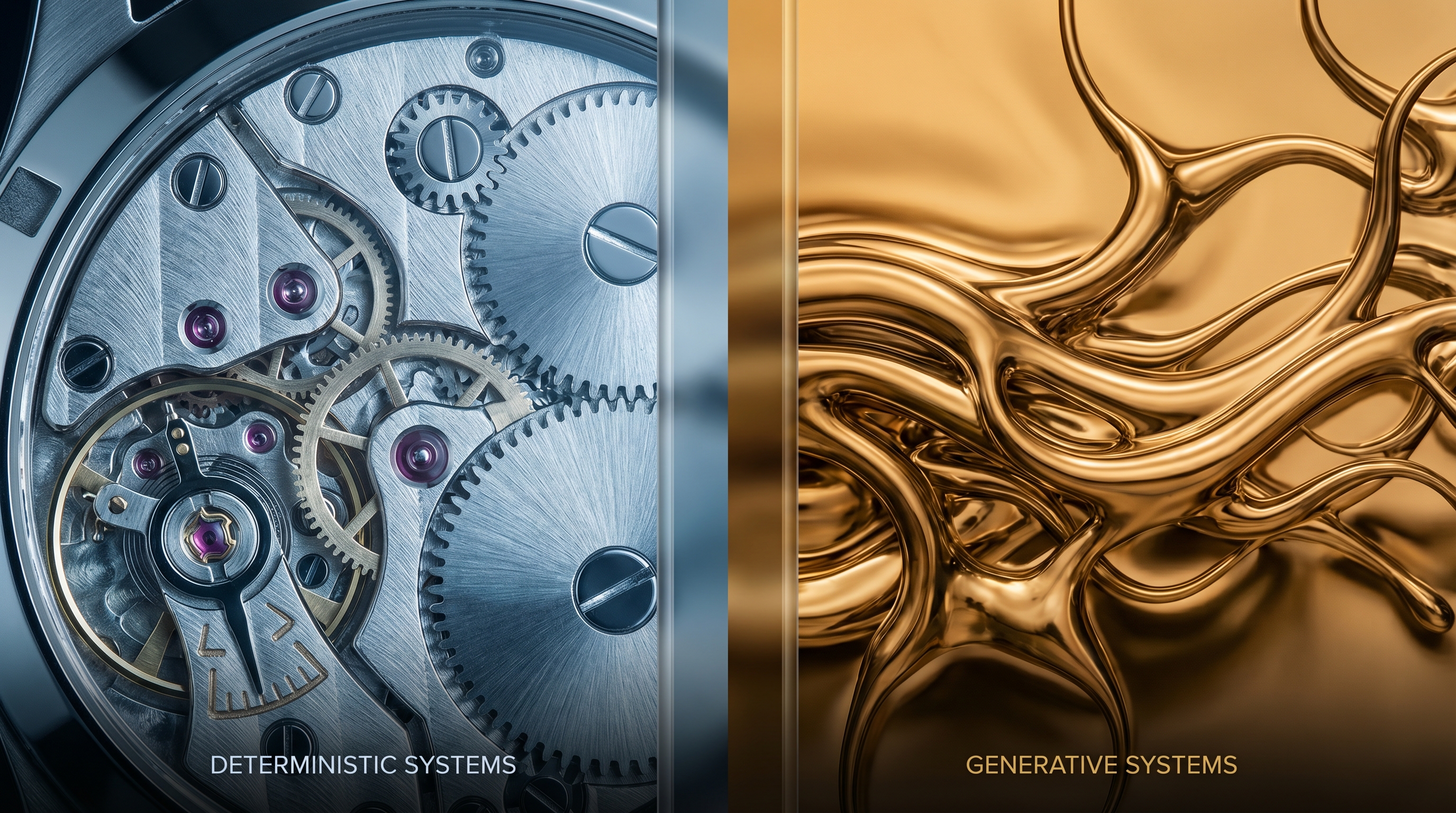
Deterministic AI vs. Generative AI: Why Your Enterprise Needs Both
Generative AI is creative. Deterministic AI is reliable. The companies winning in 2026 know exactly when to use which.
14 min readQuestions & Answers
The questions leaders ask.
AI investment without a clear architecture is expensive. These are the questions that separate outcomes from experiments.
How are you different from Accenture, McKinsey, or the Big 4?
They sell strategy decks and staff augmentation. We build systems. No 200-page report that sits on a shelf. No team of 30 juniors billing hours. We identify your three highest-impact workflows, build the AI to automate them, and hand you the keys. If it doesn't work, you don't pay. They can't say that.
What is Operational Intelligence?
Most companies use AI to answer questions. Operational Intelligence uses AI to run your business. It's the difference between a chatbot and a system that identifies bottlenecks, automates decisions, and measurably improves your operations, every day, without you babysitting it.
Why do 95% of enterprise AI projects fail?
They treat AI as a technology problem. Buy the model, plug it in, hope for the best. It's an architecture problem. Without persistent memory, structured reasoning, and deterministic outputs, you get a system that's right some of the time, which in operations means wrong enough to be dangerous.
What does "deterministic AI" mean?
Most AI is probabilistic, it gives you the most likely answer. Deterministic AI gives you the right answer, consistently. Same input, same output, every time. That's what your operations need. You can't run a business on "probably."
What is the INSIGHTS assessment?
A two-week diagnostic that maps your operations, identifies your three highest-impact AI opportunities, and puts a dollar figure on each one. You walk away with a prioritized roadmap, not a theory. It's where every engagement starts because we don't guess. We measure.
Do you offer a guarantee?
Yes. We identify and automate your three highest-impact workflows with measurable results in 90 days, or you don't pay. We can make that promise because we use deterministic AI and start every engagement with the INSIGHTS diagnostic. We know what will work before we build it.
How fast can we see results?
INSIGHTS assessment: two weeks. First automated workflows: 90 days. Most consultancies need six months just to scope the project. We identify what to fix in two weeks. That speed comes from having a diagnostic methodology that's already been built, we're not starting from scratch on your dime.
How is this different from just using ChatGPT or other LLMs?
LLMs are powerful but stateless, every request processed in isolation, no memory, no consistency. PRISM adds the layers they're missing: persistent memory, structured reasoning, and deterministic decision-making. LLMs are the engine. We build the vehicle your operations actually ride in.
What happens after you leave? Do we depend on you?
No. That's the point. We build the systems, then transfer them completely. Full documentation, hands-on training, clean handoff. You own the workflows, the data, and the outcomes. We don't build things you can't run without us. Sovereignty isn't a feature, it's the architecture.
How do you ensure data security and privacy?
Claude Guard: nine security layers built into the architecture, not bolted on after. On-premise deployment options, end-to-end encryption, post-quantum cryptography via NEXUS-MAGE. SOC 2 compliant. HIPAA and GDPR ready. Your data never leaves your control.
What industries do you work with?
Healthcare, financial services, manufacturing, logistics, professional services, and technology. Our platform is industry-agnostic, the same intelligence architecture adapts to your domain. What changes is the workflow configuration, not the foundation.
What is Precognition?
60% of searches never click a link. Your buyers are asking ChatGPT, Claude, and Perplexity, not Google. Precognition optimizes your brand across nine AI discovery channels simultaneously. We track your Share of Model and ensure you're present and preferred wherever AI influences a decision.
Can you integrate with our existing systems?
Yes. SAP, Oracle, Microsoft, Salesforce, HubSpot, data warehouses, custom applications. Secure APIs. We enhance your existing investments, not replace them. The fastest path to results is building on what you already have.
What's the best way to get started?
A conversation. We'll discuss where you are, what's not working, and where the biggest opportunity is. From there, the INSIGHTS assessment tells you exactly what to focus on, in two weeks, not six months. No commitment beyond the conversation.
These are just the beginning. We have written detailed answers to 75 questions enterprise leaders ask about AI.
Browse all 75 questionsGet In Touch
Start the Conversation
Tell us where you are. We'll tell you exactly where the opportunity is, and what it's worth.