What is the difference between deterministic AI and probabilistic AI?
The answer
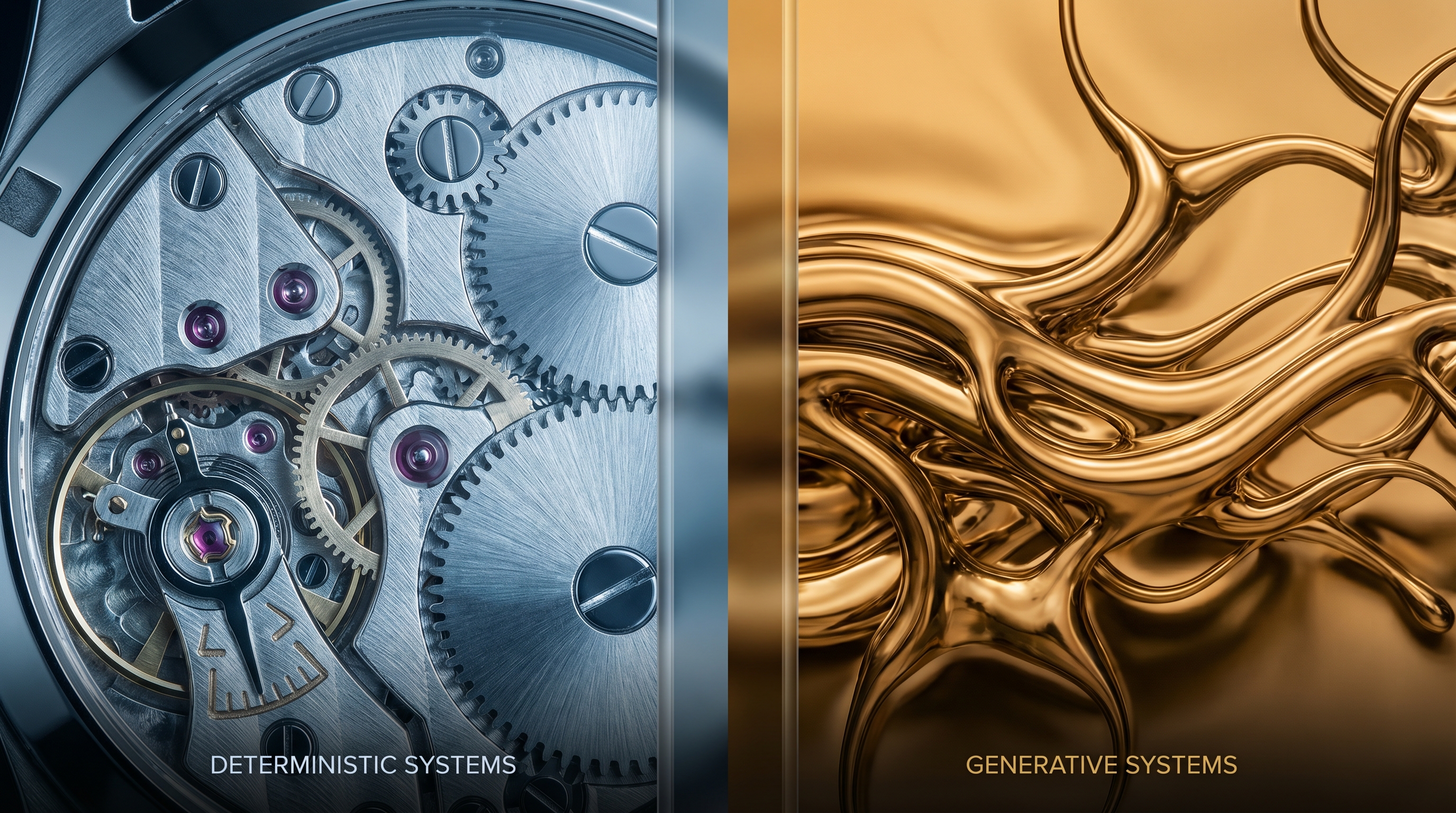
Deterministic AI gives the same answer every time you ask the same question. Probabilistic AI gives different answers with varying levels of confidence. One is a calculator. The other is a very educated guess. For business decisions that must be consistent, auditable, and defensible, deterministic AI is the only choice. For creative work, exploration, and communication, probabilistic AI adds genuine value.
Source: SynthesisArc, 2026
The full picture
The distinction is fundamental, and getting it wrong is how enterprises waste millions. Deterministic AI follows explicit rules and produces fixed outputs. If you feed it the same data twice, you get the same answer twice. You can audit it. You can explain it. You can guarantee it.
Probabilistic AI, which includes all large language models, produces outputs by sampling from a probability distribution. The same input can produce different outputs each run. This is not a bug. It is the design. The variation is what makes it powerful for creative tasks, synthesis, and handling ambiguous input.
The enterprise mistake is using probabilistic AI for deterministic jobs. Compliance decisions, financial calculations, clinical protocols, inventory triggers. These need the calculator, not the fortune teller. The variance that makes ChatGPT interesting in a conversation makes it dangerous in a regulated workflow.
SynthesisArc's PRISM uses both. Deterministic logic handles the decisions that must be right every time. Probabilistic AI handles the communication, reasoning, and edge-case interpretation where flexibility adds value. The architecture decides which layer runs at each step. That is what makes it production-ready.
Apply this thinking
The SynthesisArc products that put this into production.
Go deeper
Field Notes on this topic.
Ready to put this into production?